
10 Timesheet Errors That Are Killing Your Staffing Profitability
📅 Updated on:March 27, 2026
📅 Created on:March 27, 2026

Joseph Mathew
Timesheet errors may seem like minor administrative hiccups, but for staffing firms they represent an alarming and costly drain on profitability. Every inaccurate time entry, every missed clock-in, every misapplied pay rate flows rapidly downstream to cascade into payroll errors, billing disputes, compliance fines, and damaged client trust.
The financial consequences of timesheet errors are substantial. According to an EY report, inaccurate or missing timecards cost businesses roughly $78,700 per 1,000 employees working annually. For high-volume staffing firms managing hundreds of contractors across multiple locations, the risk is even greater. When timesheets feed both payroll and client billing, a single timesheet error does not just affect one paycheck but ripple into revenue leakages, increased turnover, and decreased productivity.
This guide details the ten most common timesheet errors that erode staffing profitability, the primary causes of such timesheet errors in the timesheet-to-payroll process, and provides practical solutions to prevent these errors before they impact your bottom line.
| Key takeaways. |
| • Even a 1–2% timesheet error rate across thousands of timesheets, can add to significant financial losses every month. |
| • Most errors are a result of manual time tracking, unclear timesheet policies, and disconnected systems between timesheet capture and payroll. |
| • Staffing firms can reduce the impact of such errors by automating the timesheet reconciliation process using validation rules, approval workflows, and regular audits. |
| • Clean timekeeping data is not just a payroll requirement—it is the foundation for accurate billing, margin protection, and strategic decision-making. |
The Direct Link: Timesheet Errors to Profitability Loss
In staffing, profitability is directly tied to billable hours. The timesheet-to-payroll and timesheet-to-billing processes comprise the heart of staffing back-office operations: as timesheets determine what workers are paid, what clients are invoiced, and what margins the firm earns on every placement. When employees’ timesheets contain errors, including wrong hours, incorrect time entries, missing approvals—those mistakes propagate through payroll, billing, and financial reporting simultaneously.
Consider this math. If your staffing firm bills 50,000 hours per month and has a 2% underbilling rate caused by timesheet inaccuracies, that is 1,000 billable hours lost every month. At an average bill rate of $45 per hour, that is $45,000 in revenue leakage. So, your firm books this loss not due to lost clients or market downturn, but due to incorrect timesheet data processed in the payroll and billing workflows.
For business owners and senior leaders of staffing industry, timesheet errors cannot be treated as a minor back-office inconvenience. They are a direct threat to cash flow, working capital, and hinder strategic decision-making.
The 10 Timesheet Errors and Their Profitability Impact
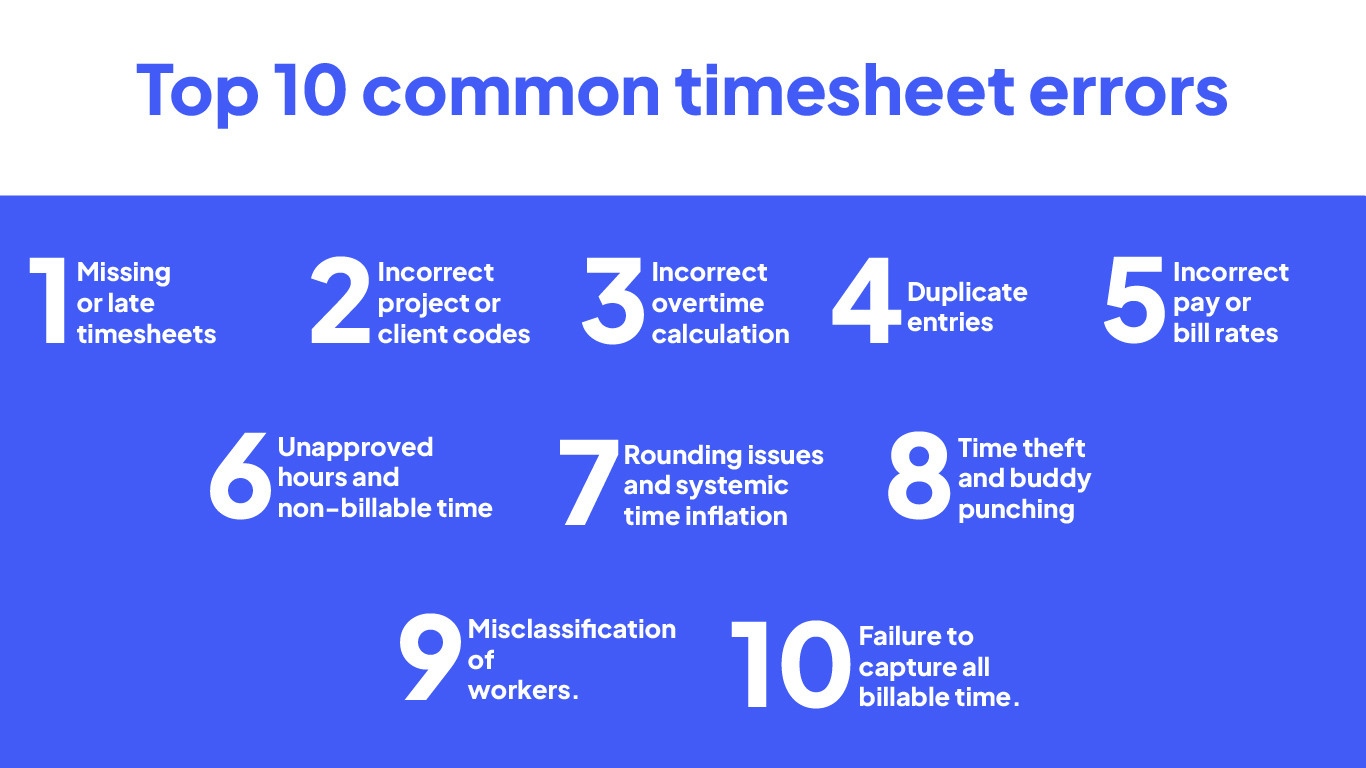
Here are the most common timesheet errors that staffing firms encounter regularly, along with their real-world impact and practical guidance on identifying these errors and resolving them with ease.
1. Missing or Late Timesheets
Employees forget to submit timesheets on time or miss them entirely. In staffing, where payroll deadlines are tight and billing cycles depend on approved hours, late timesheets delay everything downstream. Payroll cannot process paychecks without timesheet hours, and clients cannot be invoiced when data is incomplete. The administrative burden involved in following up for missing timesheets across multiple client locations, hampers the workflow of each payroll and billing cycle.
Staffing scenario: A light industrial worker at a warehouse client does not submit their timesheet by Monday’s deadline. The timesheet coordinator spends half a day tracking down the missing hours, delaying the entire payroll batch by a day. The client invoice is then pushed back a week, and cash flow slips for that month.
2. Incorrect Project or Bill Codes
When employees attempt to log hours under the wrong project or client code, the result is mismatched records that create billing errors leading to incorrect client invoices. Correcting timesheet errors of this type requires manual reconciliation by payroll specialists which further increases administrative overhead and erodes client confidence.
Staffing scenario: A consultant logs 10 hours to Project A instead of Project B. The wrong invoice is issued with incorrect billing rate, triggering a dispute that takes multiple days of administrative time to resolve, plus the reputational cost of sending an inaccurate invoice.
3. Incorrect Overtime Calculations
Overtime errors are among the most costly timesheet mistakes in high-volume staffing environments. Overtime rules differ across each state; California requires overtime pay after 8 hours in a single day, while most states calculate it weekly. When a time tracking system does not apply jurisdiction-specific rules, or when manual time tracking is used to calculate breaks and overtime, the risk of incorrect time reporting increases dramatically. Overpaying for such employee overtime reduces staffing margins directly. While underpaying invites compliance fines and penalties under labor laws.
Staffing scenario: A staffing firm places workers in both Texas and California. A payroll coordinator using a spreadsheet applies weekly overtime rules to all workers at a uniform rate, missing California’s daily overtime threshold. Ten workers are underpaid, triggering back-pay obligations and a state labor inquiry.
4. Duplicate Entries
When the same work hours are entered twice—whether by accident, a system fault, or employees submitting through multiple channels—the result is double payment or duplicate billing. For staffing firms pulling timesheets from VMS portals, time clocks, and manual submissions simultaneously, duplicate time entries are a recurring risk. Without automated error detection, these duplicates may not surface until a later audit, by which point the financial damage is already incurred.
Staffing scenario: An employee’s timecard records the overtime hours while it’s pulled from the VMS portal, but the same OT hours are also submitted through a separate ticket on the HRMS/HRIS platform. Paycheck is issued while considering the inflated count of overtime hours and this overpayment is only identified during end-of-month reconciliation.
5. Incorrect Bill or Pay Rates
Applying the wrong pay rate to an employee or the wrong billing rate to a client is one of the most damaging timesheet errors. In staffing, where pay rates vary by client, assignment, skill level, and shift, maintaining rate accuracy is complex. A single rate mismatch on a 20-hour work assignment can lead to $500 in lost revenue. When pay rates are manually managed in a spreadsheet rather than enforced by a robust system, the risk of such errors multiplies with every new placement.
Staffing scenario: A contractor is billed to a client at $50/hour instead of $75/hour because the rate table was not updated after a contract renewal. Over a month, the firm loses $5,000 in revenue on a single placement, and it’s doubtful whether such lost revenue can be recovered retroactively.
6. Unapproved Hours and Non-Billable Time
When employees log hours or activities that managers have not approved, the firm may pay for work that cannot be billed. Non-billable hours, including unauthorized research, unlogged travel time, or activities outside the scope of the client agreement, would increase labor costs without generating corresponding revenue. This is one of the causes of timesheet errors that is hardest to detect without a structured approval workflow.
Staffing scenario: Five temporary workers each log an extra hour of “site orientation” that was not included in the client agreement. The firm pays $375 in wages that cannot be invoiced, and the pattern repeats weekly until a manager’s review catches it.
7. Rounding Issues and Systemic Time Inflation
Rounding time entries to the nearest 15 minutes is common practice, but inconsistent rounding creates systematic overpayment. If employees clock in minutes early and round up, or if punch clocks apply rounding rules that favor the employee, the cost accumulates silently. Rounding issues across 50 employees working full-time can inflate thousands of dollars in annual labor costs.
Staffing scenario: A staffing firm rounds time to the nearest quarter hour. Fifty warehouse workers each gain an average of 15 extra minutes per day from favorable rounding. Over a year, this adds up to over 1,000 hours of paid but unworked time, a direct margin reduction for the staffing firm.
8. Time Theft and Buddy Punching
Time theft occurs when employees deliberately record more hours than their actual work; clocking in early, leaving late on paper, or having a colleague punch for them. Buddy punching is particularly common in environments that rely on shared punch clocks or access cards or paper timesheets without biometric verification. For staffing firms managing workers across multiple locations, time theft is difficult to detect through manual processes alone.
Staffing scenario: A worker at a client warehouse asks a coworker to clock in for them 30 minutes before they actually arrive. Over a month, the firm pays for 10 hours of unworked time per employee—a direct loss that only surfaces when the client questions headcount versus output.
9. Misclassification of Workers
When staffing firms incorrectly classify workers, such as treating a contractor as an employee or vice versa, the consequences for payroll and billing are serious. Misclassified workers may receive overtime pay they are not entitled to or miss benefits they should receive. Compliance issues from misclassification can result in regulatory penalties, back-tax obligations, and lawsuits. This error originates from the timesheet data but manifests in every payroll cycle, creating discrepancies between what was paid and what should have been paid.
Staffing scenario: A contractor classified as an employee receives overtime and health benefits for six months before an audit catches the error. The firm faces $12,000 in overpayments plus compliance fines from the state labor board.
10. Failure to Capture All Billable Time
When employees fail to record their hours for all billable activities—prep work, travel between client sites, training, or after-hours communication—the firm loses revenue it has earned but never invoiced. This is among the most precarious timesheet errors because it is invisible: no one flags a missing entry that was never submitted. Employee timesheets that underreport hours worked means that the firm absorbs labor costs that should have been billed. Over time, this pattern of lost billable time erodes project profitability and distorts the firm’s understanding of its true cost per employee.
Staffing scenario: A consultant forgets to log 30 minutes of daily prep time before client calls. Over a month, 12 billable hours are not billed at all, resulting in $540 of revenue leakage.
Where Errors Enter the Staffing Timesheet-to-Payroll Process
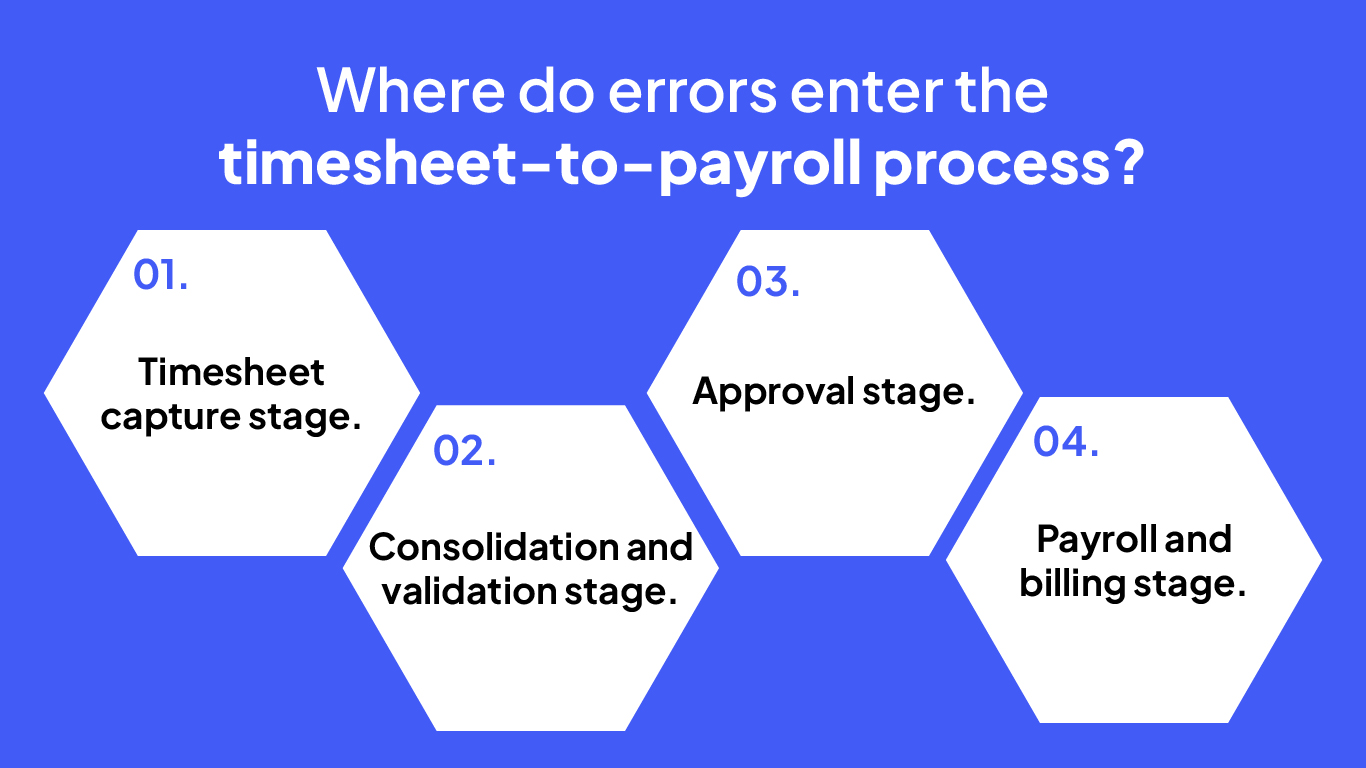
Understanding where the most common timesheet errors originate in the staffing workflow can help firms plan for their prevention. The timesheet-to-payroll process in staffing firms has more potential errors than a standard employer because timesheet data flows through more systems and involves more parties.
1. Timesheet capture stage
Workers record their hours through VMS portals, time clocks, mobile apps, or paper timesheets. Errors at this stage—incorrect time, missing clock-ins, buddy punching, forgotten entries—propagate through every downstream step. Staffing firms that rely on manual data entry at this stage witness the highest error rates.2. Consolidation and validation stage
Timesheets from multiple sources including VMS portals, manual uploads, time tracking tools must be consolidated into a single payroll-ready data set. For firms relying on spreadsheets or disconnected systems, this is the stage where duplicate entries, rate mismatches, and missing timesheets most commonly surface. Manual processes at this stage multiply errors rather than catching them.3. Approval and Audit stage
Managers and supervisors review their timesheets and approve hours before payroll processing. When this step is rushed or performed without adequate context, such as visibility into billable versus non-billable hours, adherence to state & federal guidelines, compliance norms, then unapproved or inflated hours might pass through to payroll and billing workflow.4. Payroll and billing stage
Validated, approved timesheets flow into the payroll system for payment processing and into the billing system for client invoicing. If the data reaching this stage contains errors, both payroll and billing are wrong simultaneously—employees may not be paid accurately, and clients receive incorrect invoices. This is the final stage where financial losses are realized due to the timesheet errors that emerged upstream in the workflow.The Financial Imperative: Why Senior Staffing Leaders Must Act
For senior leaders and business owners, timesheet errors represent a systemic risk to overall profitability that extends far beyond payroll.
1. Financial losses compound silently
A 1–2% error rate across hundreds of timesheets each week translates into tens of thousands in lost revenue monthly. These might not receive the visibility as other business failures, but they persist as systemic inaccuracies responsible for leaking cashflows under the radar until a quarterly review or client audit reveals the damage.
2. Cash fow disruptions
Late or inaccurate billing caused by timesheet errors delays payment from clients, increases borrowing costs, and restricts working capital. Irregular cash inflows limit the firm’s ability to reinvest in staffing operations, technology, or hiring.
3. Client trust and employee morale
Clients expect accurate invoices. Workers expect to be paid accurately and on time. Repeated inaccuracies erode both relationships. Employee dissatisfaction from payroll errors leads to increased turnover and in staffing sector, where the workforce is the product, turnover is a direct hit to capacity and revenue.
4. Compliance risks
Incorrect overtime calculations, misclassified workers, and incomplete records expose the firm to regulatory requirements violations, compliance fines, and legal liability. These are not mere theoretical risks, but such audit mistakes can carry real financial consequences.
5. Unreliable strategic data
If timesheets are inaccurate, every dashboard, labor cost report, and profitability analysis built on that data is unreliable. Leadership cannot make sound decisions about pricing, staffing levels, or market expansion when the underlying data is flawed.
Solutions: Turning Pain Points into Profit Centers
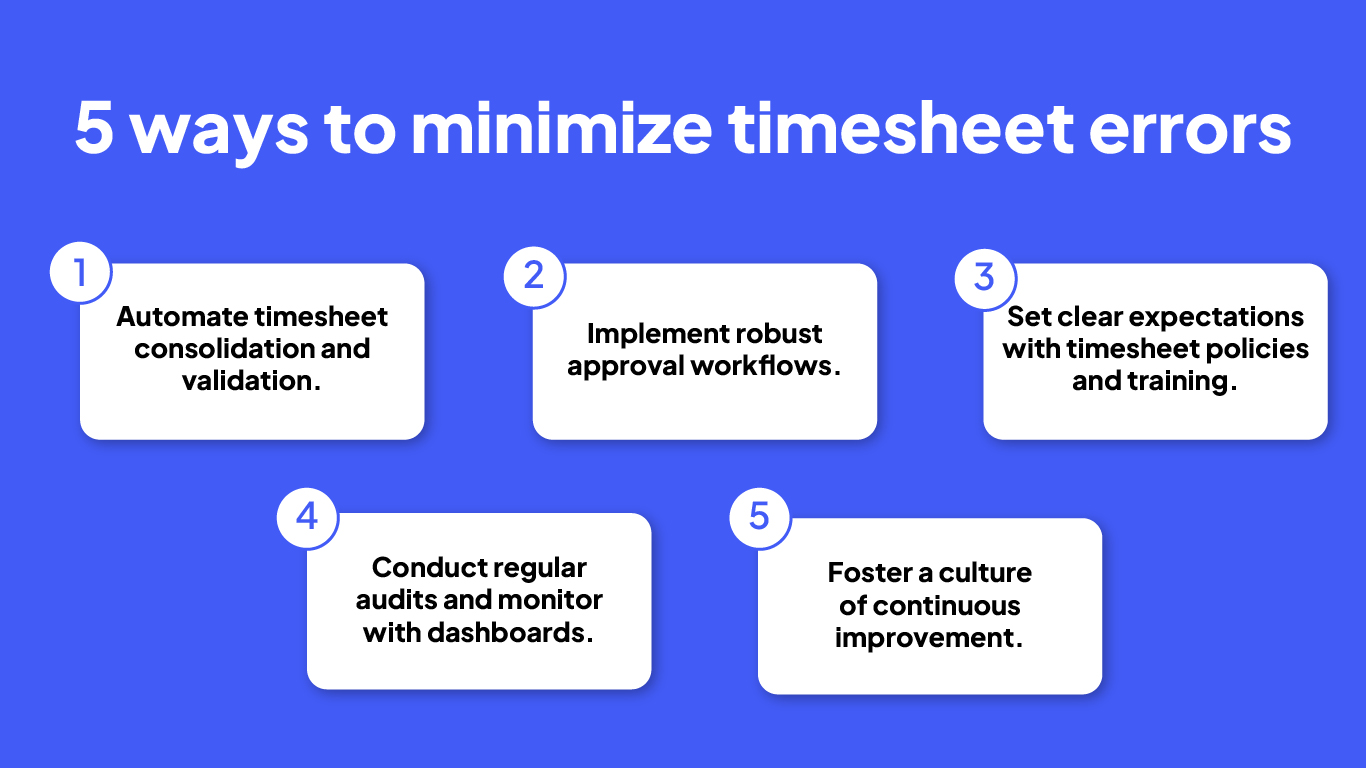
The most effective approach to minimize timesheet errors combines technology, process discipline, and organizational accountability. Here is how staffing firms are orchestrating their timesheet-to-payroll and billing process by solving these problems practically.
1. Automate timesheet consolidation and validation
- Manual time tracking and consolidation is the primary source of timesheet errors. Replace paper timesheets, spreadsheet-based tracking or workflows, and manual data entry with purpose-built software that downloads, validates, and consolidates time data automatically. Automated timesheet reconciliation software eliminates the manual processes that introduce errors at every step—from timesheet downloads to payroll submission.
einTime, an Automated timesheet reconciliation platform, automates the entire timesheet-to-payroll process for regular and off-cycle payroll: extracting employee timesheets from multiple clients’ VMS portals, validating timesheet hours against business rules, state and federal norms, flagging the exceptional cases for review, adding provisions for payroll adjustments, undertaking payroll audit and producing payroll-ready file ready for processing by Payroll software.
- The platform integrates with payroll systems, billing platforms, and accounting software, including ADP, Paychex, Dynamix 365 and other widely used tools, to ensure that validated timesheet data, with zero errors, flows accurately into every downstream system. As a timesheet reconciliation software purpose-built for staffing, einTime replaces fragmented manual workflows with a single, validated pipeline.
For staffing firms, the impact is immediate: significantly reduce the payroll processing time, fewer off-cycle corrections, and accurate client billing. Timesheet reconciliation software with built-in validations can help staffing payroll teams to process paychecks at 3X faster rate with 100% accuracy compared to manual processes.
2. Implement robust approval workflows
- Multi-level approval workflows ensure that timesheets are reviewed by the right stakeholders i.e. project managers, HR, and finance, before they reach payroll process. Effective workflows route all timesheets with supporting context: approved hours, variance alerts, and exception flags. This allows employees and managers to catch errors collaboratively rather than relying on a single reviewer. Audit trails log every approval, creating accountability and documentation for compliance.
3. Set clear expectations with timesheet policies and training
Many timesheet errors stem from a lack of process discipline. Set clear expectations by publishing timesheet policies that deliver clear instructions: how to log work hours correctly, what constitutes billable versus non-billable work, and how to log time for breaks and overtime. Train employees or contractors to record their hours accurately at the point of work rather than calculating them from memory, before the submission deadline. Training should cover the company’s VMS portals or time tracking tools, common error types, and the financial impact of such inaccuracies.
- Review and update these timesheet policies regularly. As the firm takes on new clients, enters new jurisdictions, or adopts new client VMS portals or time-tracking tools, the policies must evolve to reflect current operations and regulatory requirements.
4. Conduct regular audits and monitor with results
- Prevention is the goal, but detection matters too. Schedule monthly audits of timesheets to identify patterns: repeated late submissions, frequent rate mismatches, overtime spikes, or departments with consistently higher error rates. Reporting dashboards provide real-time visibility into time tracking accuracy, enabling leadership to spot issues before they compound.
Use dashboard analytics to track time accuracy per employee, per client, and per location. Correcting timesheet errors is always more expensive than catching them during the audit cycle. Build a feedback loop between audit findings and process improvements so that each cycle performs better than the last.
5. Foster a culture of continuous improvement
- Accurate timekeeping is not a one-time fix; it is an ongoing discipline. Gather feedback from employees and managers to refine the time tracking process. Establish communication channels between payroll, operations, and staffing teams so that recurring issues are identified and resolved at the root cause.
The combination of automated timesheet process, structured validation, clear policies, and regular audits does not just reduce payroll errors and timesheet inaccuracies. It transforms timekeeping from an administrative burden into as competitive advantage—one that protects margins, accelerates billing, and builds long-term operational efficiencies.
Maximize Your Staffing Profitability with einTime
Accurate timesheet data helps staffing companies by driving growth, retaining client trust, and improving profitability in a competitive staffing market. With einTime, staffing firms move from error-prone manual processes to a streamlined, integrated platform that minimizes errors, ensures faster billing, and keeps payroll operations financially accurate.
einTime’s automated timesheet-to-payroll reconciliation platform is purpose-built for staffing:
- ✅ Automated timesheet extraction from VMS portals
- ✅ Intelligent validations against pay and bill rates,
- ✅ Multi-level approval and audit workflows
- ✅ seamless integration with payroll service providers and billing systems.
The result is faster payroll and billing cycles, almost negligible errors and improved business margins that reflect the work your team actually delivers.
👉 See how einTime helps staffing firms eliminate timesheet errors and boost their bottom line. Request a demo today.
FAQs
The most common timesheet errors in staffing firms include missing or late submissions by employees or contractors, entering incorrect project or client codes, overtime miscalculations, logging-in duplicate timesheet entries, applying wrong pay or bill rates, recording unapproved hours, rounding inconsistencies, time theft and buddy punching, worker misclassification for payroll, and failure to capture the complete billable time. These errors typically emerge due to manual timesheet process including excel-based timesheet consolidation and validations, manual timecard uploads, disconnected systems across payroll and billing workflows. While each timesheet mistake may seem minor, they compound rapidly across hundreds of contingent workers to create payroll inaccuracies, billing disputes, and compliance exposure that erodes profitability every cycle.
Staffing agencies can minimize timesheet errors by replacing manual processes with automated timesheet consolidation and validation systems that capture timesheet data directly from VMS portals, consolidate them and implement validation rules that flag discrepancies — rate mismatches, overtime threshold breaches, duplicate entries — before the timesheets reach payroll process. Staffing firms can also publish clear timesheet policies including submission deadlines, billable versus non-billable hours, overtime logging rules; also, create a regular schedule to train employees during onboarding and enforcing them through automated reminders. Finally, conduct monthly audits and use analytics to identify recurring errors and design long-term solutions.
When a timesheet has been submitted and locked, most payroll systems allow corrections through adjustment entries or off-cycle payment runs rather than modifying the original record. Document the specific error — incorrect hours, wrong rate, missing time — and submit a formal correction request through your payroll or HR team. The adjustment should reference the original timesheet for audit trail purposes. Many platforms, including einTime, maintain complete records of both the original submission and the correction. To prevent recurrence, implement pre-submission validation that catches errors before the timesheet is locked, reducing the need for post-submission corrections.
Timesheet errors directly impact profitability as they result in overpayments, underbilling, and off-cycle corrections by payroll and billing teams. A 2% error rate across 50,000 monthly hours can mean $45,000 in lost revenue. Repeated paycheck errors can hurt employee morale, productivity and increase turnover. Inaccurate timesheet data also undermines every margin report, dashboards, and strategic staffing decisions that rely on labor cost and utilization metrics. Beyond the immediate financial impact, timesheet inaccuracies also delay client invoicing, disrupt cash flow, and trigger compliance penalties for overtime or tax miscalculations.
Timesheet mistakes are critical for organizations because they directly influence three critical business functions: payroll, billing, and compliance. Inaccurate timesheets would mean that workers are not paid correctly, clients are not invoiced accurately, and regulatory records are not compliant anymore. For staffing firms, where margins depend on the difference between pay rates and bill rates, even small errors can cascade into huge revenue leakage. Beyond the financial impact, timesheet inaccuracies also hurt employee morale, client trust, and damages the data quality for leadership decision-making.
Author
Joseph Mathew is an award-winning Payroll leader with 20+ years of experience, building and managing global payroll teams in staffing and tech industry. Joseph currently heads the Product team at einTime. He believes that automation could help transform the timesheet lifecycle in staffing and talent agencies. He advocates for adoption of technology as means to achieve operational excellence and build sustainable competitive advantage.
Aim For the Next Level of Operational Excellence
Let’s Connect! Book your consultation now.